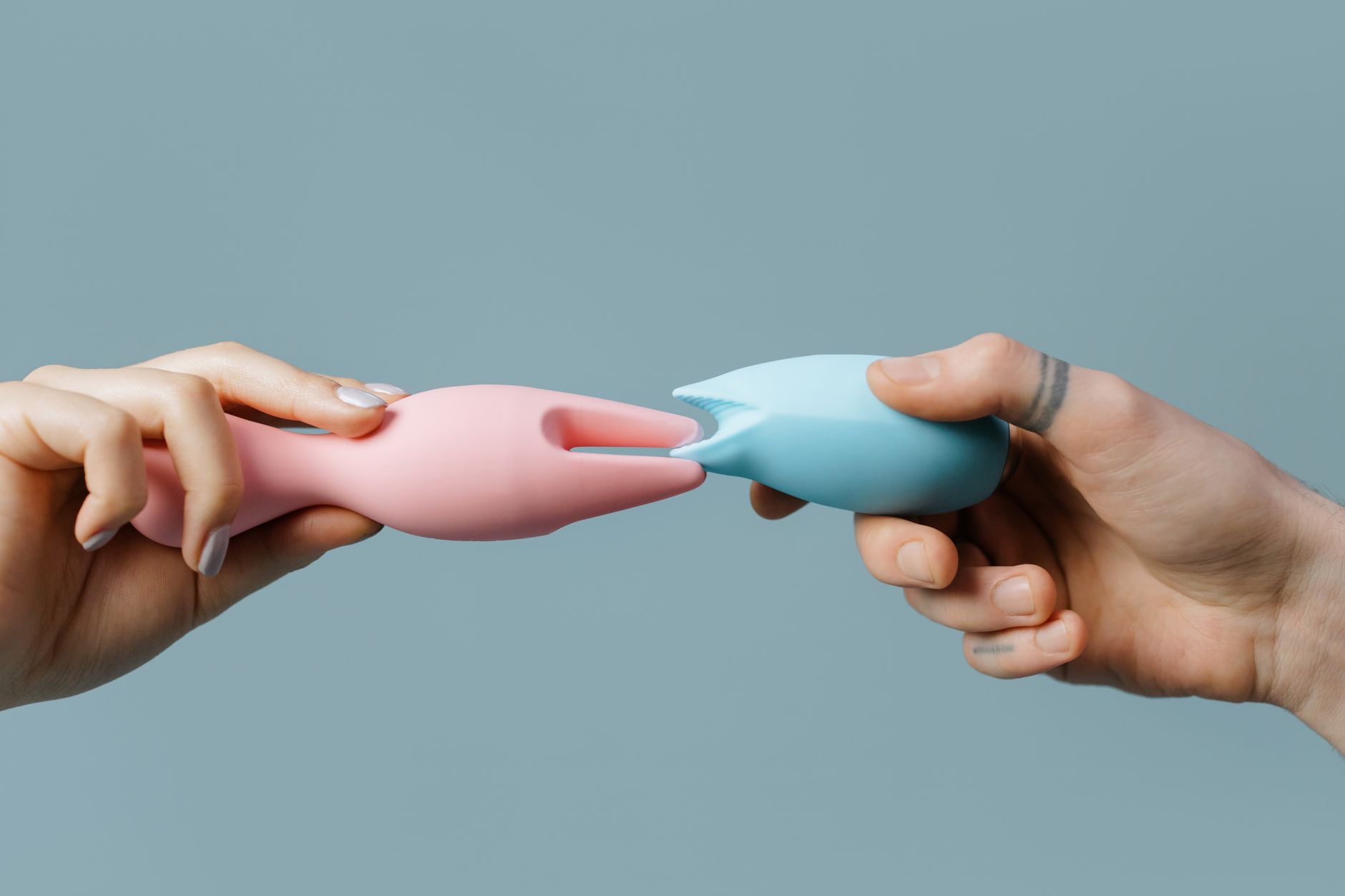
Here's the thing about introducing toys to partnered sex
It doesn't have to feel like a negotiation. And it definitely doesn't have to feel clinical, performative, or like someone's admitting defeat. The awkwardness people dread usually comes from treating it like a confession instead of an invitation. A lemon vibrator, specifically, changes the dynamic because it doesn't replace your partner's touch. It enhances it. That's a fundamentally different conversation.
I've worked with hundreds of couples navigating this exact moment. The ones who move through it smoothly aren't the ones with perfect communication skills or zero anxiety. They're the ones who separate the mechanics from the emotion and approach it with curiosity instead of pressure.
Why lemon vibrators feel different in partnered contexts
A lemon clitoral vibrator operates using air-suction technology, which means it doesn't require the kind of direct friction that can feel competitive or isolating during partnered sex. Your partner can see it, touch around it, feel the vibration, and participate actively. Compare that to a traditional vibrator that can feel like a barrier between you, and suddenly the physics change the psychology.
Hello Nancy's lemon vibrator, for instance, is designed with a narrower stem and a compact head. That shape and size mean your partner can stay close during use. They can caress your thighs, kiss your neck, or hold you while you're using it. The toy doesn't create distance. It creates space for them to participate differently.
This matters psychologically more than people realize. Couples who reported highest satisfaction with toy use weren't necessarily using the toy for longer or more frequently. They were using it in positions and moments where they felt connected to their partner, not adjacent to them.
The conversation blueprint that actually works
Start outside the bedroom. This isn't a mood-killer sentence. It's actually the opposite. If you're already under the sheets, the conversation carries a charge it shouldn't. You're activating defensive instincts right when vulnerability would serve better.
Try this opening: "I've been thinking about something that might feel good for both of us, and I wanted to bring it up when we're just talking." That's it. You're not confessing. You're not apologizing. You're naming it as a shared project.
Then be specific about your actual interest, not hypothetical. Don't say "Some couples use vibrators." Say "I've been curious about trying a lemon vibrator, and I think the way it works might feel really good for me and might be something we could explore together." The difference is ownership. You're not suggesting something abstract. You're telling your partner about your desire.
Expect questions. Expect some initial awkwardness. That's completely normal and doesn't mean anything is wrong. Give your partner time to sit with the idea. Don't push for an answer that night. People often need a day or two to move from "surprising information" to "actually excited about this."
What not to do (the mistakes I see most often)
Don't frame it as a problem-solver for something your partner is doing wrong. If you're introducing a lemon clitoral vibrator because you're not orgasming, that's true and valid. But the conversation can't center on your partner's failure. It has to center on exploration. The distinction sounds subtle and it's absolutely critical.
Wrong: "I haven't been finishing, so I think we need to try this." Right: "I want to experiment with what feels best for my body, and I think trying this together could be really fun."
Don't surprise your partner with a toy during sex, even as a spontaneous gesture. That creates a moment of shock instead of choice. Your partner deserves to consent and prepare emotionally before something new enters your intimate space.
Don't assume your partner won't want to be involved. Many partners worry they'll be replaced or sidelined. The opposite is true for lemon vibrators, which work best when they're woven into partnered sex, not separate from it. Make that clear from the start.
How to actually use it together (the practical part)
Start by using it solo in front of your partner, if that feels comfortable. No performance required. Just let them see how it works, hear what the sensation is like, and watch your body respond. This demystifies it. It also gives your partner permission to be curious without pressure.
Then experiment with positioning. You could be lying on your back with your partner inside you while you use the lemon vibrator on your clitoris. You could be facing each other with the vibrator between you. You could be receiving oral sex while using it. The combination possibilities are extensive, and discovery is part of the fun.
Start with lower intensity settings. You want to be relaxed enough to enjoy sensation and your partner's presence simultaneously. Higher intensity can feel good solo, but in partnered sex, it sometimes creates a narrowing of focus that pulls you away from connection. Give yourself time to find the sweet spot.
Keep your hands and attention available. Hold your partner. Make eye contact. The toy is an instrument, not the main event. The main event is still the two of you.
The emotional layer people skip over
Introducing new elements to sex often brings up feelings that seem disproportionate to the actual subject. Your partner might feel insecure, even if they logically understand that a toy isn't about them. You might feel self-conscious about wanting something external, even though wanting pleasure isn't about inadequacy.
These feelings are real and they're not problems to solve. They're information to acknowledge. A conversation after the first time using it together might sound like: "How did that feel for you? What was good? What felt weird? What do you want to try differently?" Not "Did I seem like I was enjoying myself more?" That's a different conversation entirely.
Couples who navigate this successfully aren't the ones who avoid the emotional dimension. They're the ones who name it directly. "I was nervous you'd feel left out." "I was worried you'd think I didn't want you anymore." Saying these things out loud deflates their power.
When to bring in a professional
If your partner refuses conversation entirely, that's information. That's not a toy problem. That's a communication problem, and it might warrant talking to a couples therapist. If introducing a toy becomes a power struggle or a breaking point, the toy isn't the issue. Something else is, and it deserves real attention.
If you're using the toy as a workaround for unresolved sexual incompatibility, that can work temporarily, but it usually doesn't resolve the underlying misalignment. Using a lemon vibrator should feel like an enhancement to connection, not a band-aid on a fracture.
FAQ: Questions couples actually ask
How do I know if my partner will be into this?
You don't, and that's the point. You ask. You create space for them to be honest about their feelings without judgment. Some partners love the idea immediately. Some need time. Some need to try it first before they decide how they feel about it. All of those responses are okay.
Will using a toy make my partner feel replaced?
Not if you frame it correctly and use it in ways that keep them involved. Lemon vibrators are particularly good for this because of their design and the way they integrate into partnered sex rather than replacing it. But the conversation matters more than the tool. If your partner feels secure in your attraction to them and included in the decision, they're far less likely to feel sidelined.
What if we try it and it feels weird or doesn't work?
Then you stop. You talk about what felt weird. You decide together whether to try again differently or set it aside. This isn't a failure. This is experimentation. Some couples find that lemon vibrators work beautifully for them. Others discover it's not their thing, and that's completely valid information.
How often should we use it?
There's no right answer. Some couples incorporate it regularly. Others use it occasionally. Some use it for a few months and then move on to something else. Let it be whatever feels natural and mutually exciting. The moment it becomes obligatory is the moment it stops working.
Should we use it every time we have sex?
Absolutely not. Variety is part of what makes sex interesting. Some sessions with the toy, some without. Some where you use it solo while your partner watches. Some where they use it on you. Some where it doesn't come out at all. The point is that it's available, not that it's required.
What if I want to use it and my partner doesn't?
That's a boundary worth respecting. You can still use it solo. You can also have a deeper conversation about what the resistance is about. Sometimes it's not about the toy at all. Sometimes it's about discomfort with a specific scenario or lingering insecurity. Understanding the root might help, or it might not. Either way, you have information.
The bigger picture
Introducing a lemon clitoral vibrator into your partnered sex life isn't about fixing anything. It's about expansion. It's about saying "I want to know more about my own pleasure and I want to share that with you." That's actually a form of intimacy that a lot of couples never get to experience.
The awkwardness people anticipate usually doesn't materialize. What materializes instead is curiosity. And curiosity is the thing that keeps long-term relationships alive and interesting. You deserve to explore what feels good. Your partner deserves to be part of that exploration in a way that feels consensual and connected.
Start with the conversation. The rest follows naturally from there.